Our most commonly asked question:
|
An invaluable set of Frequently Asked Questions, and answers, may be found on the internet newsgroup rec.heraldry.
|
Other common questions:
- I understand what the College does. How much does a Registration of Arms cost?
-
I want arms, or a crest, or a shield. I'm confused by these terms. What do I really mean?
"I understand what the College does. How much does a Registration of Arms cost?"
Currently, the total fee for Registration of Arms - whether one wishes to merely register arms granted by another legitimate heraldic authority, or chooses to have the College aid in the design and execution of new Arms - is US $395, payable to The American College of Heraldry, whether by PayPal, credit card, personal check, or money order. This includes a color certificate of the Registration of Arms, as well as a Black & White line art drawing suitable for use on stationery, etc., by the armiger.
Further, the Arms would appear in the College's quarterly, "The Armiger's News," as well as The Heraldic Register of America, a compilation of those Arms Registered with the College through a given time period which is available for sale through the College and is distributed in Adobe Acrobat (PDF) format to major universities and libraries in the U.S. and abroad. Details on registration fees may be found HERE.
As to the cost of a REGISTRATION with our organization, as opposed to a GRANT received from one of the international granting bodies, here is a breakdown of current costs (as of 11 May 2023 from the College of Arms as published on their website):
-
Personal GRANT of Arms and Crest are £8,050 (US$10,067) - The American College of Heraldry helps design and registers the same for US$395
-
Similar GRANT of Arms and Crest to an impersonal but non-profit making body, £16,455 (US$20,581) - The American College of Heraldry helps design and registers the same for US$395 - no upcharge, unless supporters are added
-
GRANT of Arms to a commercial company, £24,510 (US$30,656) - The American College of Heraldry helps design and registers the same for US$395 - no upcharge, unless supporters are added
-
When a GRANT of Arms includes the Grant of a Badge or (to eligible grantees) Supporters, or the exemplification of a standard, a further fee is payable - The American College of Heraldry does not register badges
-
A special reduced fee of £9,500 (US$11,882) has been introduced for parish, town and community councils, to cover the GRANT of Arms alone, without crest - The American College of Heraldry helps design and registers the same for US$395 – no upcharge, unless supporters are added
The Court of The Lord Lyon also publishes their fees (in much greater detail, including fees for specific "additaments"). For example, the cost of a Patent of Arms for an Individual, with Crest, is £2,825 (US$3,341). The entire listing (as of May 2019) may be seen HERE.
"I plan on registering a coat of arms with the College, but I assume I have to pay someone first to help me design armorial bearings and then get me the "inside track" for registration, right?"
Absolutely not. You definitely do not need to pay for any additional services if you want to create and register new armorial bearings with our organization.
There are heraldic artists, and other bucket shops, that state online they will help you design a coat of arms, for a fee, and will then assist you with getting those arms registered with an heraldic organization, again, for a fee.
As far as heraldic registration organizations in the U.S. are concerned, none of them mandate pre-designed armorial bearings as part of their registration services. In fact, the College's registration process INCLUDES complete design assistance, and so any monies paid to an outside individual or company to create a coat of arms prior to contacting us would be money wasted on your part.
In fact, one problem that may result from working with someone prior to registration is the design of an achievement that would be wholly unacceptable for registration. Many such companies/individuals simply "design" what the armiger tells them, including elements that would not be registerable, or, worse still, creating heraldically bad designs. On many occasions we have received "designs" from potential armigers, ostensibly created by an heraldic "artist" for a fee (often not insubstantial), that are simply lousy heraldic design. It's quite clear that the "artist" with whom the armiger worked had no idea whatsoever how the principles of heraldry work, and simply drew (or "cut and pasted" together) anything and everything the armiger asked for - usually with terrible color combinations, bad placement, etc.
Further, no individual or organization can truly assist you with the registration process (aside from providing you an address or domain name). In the US, the few existing registration bodies work directly with a potential armiger, without the need for third parties. As far as international granting agencies are concerned, those bodies prefer working directly with the armiger to design new armorial bearings - a third party would actually be a hindrance. And, more often than not, international granting entities (e.g. The College of Arms, The Court of Lord Lyon, etc) invariably modify or wholly discard initial design submissions from potential grantees.
So, beware of any business or "artist" claiming to have an "inside track" when it comes to getting arms registered (or granted). They don't.
"As there is currently no government entity established for overseeing the registration of armorial bearings to US citizens, why doesn't the American College of Heraldry, along with other existing US heraldic organizations, work together to petition Congress to establish same?"
This is a surprisingly frequent question.
There are probably somewhere between (generously estimated) 50,000-100,000 people who would be interested in government-sanctioned armorial bearings... in a nation of 340 million. As you can imagine, in a country where many people feel that something as important as NASA is a waste of money, they're not going to allocate federal funds to a United States heraldic authority where such a small percentage of the population is passionate about the idea.
Of course, legally, there is already a “standard” in place in the US - the legal assumption of arms, with no government intervention whatsoever. An individual may design and assume whatever achievement they wish, with neither government approval, nor registration with any one of the several registering organizations (like the College) that exist in this country.
In matter of fact, for those who want legal protection for their arms, the ONLY thing that might raise the issue to national attention would be:
- IF (please note, a BIG “if”) there were numerous instances of the usurpation of the arms of another (which there currently aren't, as most of the independent heraldic entities in this country do their best not to step on their countrymen’s, or fellow international contemporary or historical armigers’, toes), and,
- IF, in those instances, the offended parties sued for damages in civil court in such numbers that many cases began to appear.
Only THEN, that MIGHT get the attention of lawmakers enough to consider the idea.
The US government has lacked the political will to do this because the Founding Fathers wished to avoid a society with classes of nobility, and heraldry was historically a means of separating the nobility and gentry from the common people.
Of course, the practice of heraldry is entirely possible in a republic, but it must take a form different from that which the framers of the United States understood contemporaneously. And, as an heraldic authority was not enshrined in the foundational documents of our democracy, the exact nature that such an official body might take has been a matter of debate for decades, if not longer.
Further, given the recent penchant for political populism, there seems little prospect of developing a new government office that many would brand as "elitist" - mostly as a result of their failure to understand the nature of heraldry.
Finally, there have been attempts, in past decades, for the few “surviving” US heraldry societies (lasting more than a couple of years, NOT being buckets shops in sheep’s clothing, etc.) to “combine forces” into one amalgamated institution, believing that such a “conglomerate” society would have the size and strength to bring heraldry to the fore in the US. Unfortunately, most of these existing heraldic entities (the ACH included) cannot agree with each other upon what the "rules" would actually be.
Our own group tends to follow the “UK” model, while others are obviously only Scottish in design. Still others want to open the field for allowing the registration (not grant, mind you, as that would, and should, be limited to sovereign entities – at least in our opinion) of virtually every design element possible in heraldry, from robes of estate, to Ivy mantling, to crowns and coronets, supporters, and more.
So, at this time, we're afraid such an effort on a national/governmental scale would be more Sisyphusian than anything else.
"I want to design armorial bearings with specific symbols to denote my life/character. Which symbols mean what?"
Many individuals submit their application but aren't quite sure what they want to include in their arms, and ask us to tell them which elements to include that specifically define elements of their life, their character, their family, etc. The truth is, there is no definitive "dictionary" of heraldic meanings. Over time, certain symbols have been "assigned" traditional meaning in heraldry, and for those individuals who wish to start from scratch in their designs, here is a LIST OF HERALDIC "MEANINGS". This is not to say that these are the College's definitions for such symbols, but merely those which are commonly recognized in heraldic usage.
Of course, you may completely ignore any or all of these "definitions" and develop arms with symbols that mean something to you personally, and not everyone else.
A further explanation comes from the rec.heraldry FAQ:
Without knowing the circumstances of the original grant, it is difficult to say whether a coat means anything at all, except that someone (grantee or herald) liked the design. Some arms ("canting" arms) contain a charge whose name is related to the surname of the bearer (e.g. de Trumpington: Azure, crusily, two trumpets pileways Or). This can be taken to the extent of becoming a rebus puzzle -- the Borough of Congleton bears Sable, on water in base barry-wavy azure and argent, on a tun between two conger eels argent, a lion statant-guardant Or, which decodes to Conger-Leo-Tun.
In the Middle Ages, bestiaries, popular tales and folklore contributed greatly to the association of specific animals with specific characteristics or virtues, some of which persist to this day (owls are wise, elephants have memory, etc). It is quite possible, for any given coat, that the original bearer chose an animal with such associations in mind.
Often a coat will contain charges alluding to the original grantee's career or interests; for example medieval merchants and guildsmen often included the tools of their trade. These may become less appropriate as the coat is passed down through the generations, or their significance is forgotten. Quite elaborate schemes can be developed: a former Governor General of New Zealand has a coat based on the theme "a cat among the pigeons", which is apparently how she sees her career.
Some charges were taken from the arms of a bearer's feudal lord or protector as a mark of loyalty. For example, the Maltese cross in the arms of several towns in Switzerland is a reference to the Knights of Malta, who were once sovereign in that area. The frequency with which the bar, a type of fish, appears in coats of arms of the former duchy of Bar in Eastern France can only be explained in this way. Also, imperial eagles which appear in many Italian coats were originally meant as a sign of allegiance to the Imperial party in the conflicts which tore medieval Italy.
"I want arms, or a crest, or a shield. I'm confused by these terms. What do I really mean?"
|
|
|
SAMPLE "COMPLETE" ARMORIAL ACHIEVEMENT (click to enlarge) |
)
No doubt many of the terms of heraldry can be quite confusing, though there are some basics which are often misused or transposed (such as crest instead of arms, etc.). Here is a very brief listing of heraldic terms.
The image at right represents a "complete" armorial achievement with most of the elements that might be found in arms granted by an heraldic authority. For an example of armorial bearings that would be registered by the College, click HERE.
- ACHIEVEMENT: The full armorial honors of an armiger, e.g. shield, crest, wreath, mantling, and helm, with supporters as appropriate.
-
ARMIGER: One who is entitled to heraldic arms.
-
ARMORIAL: (1) Of or pertaining to heraldry or heraldic arms. (2) A book or treatise on heraldry.
-
ARMORY: Now usually comprised within the general term 'heraldry', it refers more specifically to the art or science of the devices borne on the shield and its accompaniments.
-
ARMS: Strictly the devices painted on the shield, it now tends to be used more loosely.
-
BADGE: (1)A distinct device which is never borne on a shield or as a crest -- although many of the fifteenth and sixteenth century badges were later also used as crests and supporters. Usually employed as a mark of ownership, or warn on the liveries of retainers. (2) A distinctive emblem adopted by many families; not worn on the helmet like a crest, but used in various modes where a crest is now employed. It was embroidered on the sleeves of servants and followers, and carved or painted in buildings, etc.
-
COMPARTMENT: The support, often drawn as a grassy mound, on which the supporters stand.
-
CREST: The device which is set upon the helm. It is quite wrong to apply this term to the coat of arms or shield. Around the base of the Crest (originally to conceal the join) is placed a wreath of the colours (the two, sometimes more, principle metals and colours of the arms); sometimes instead of a wreath there a Crest Coronet, and more rarely the Crest is set upon a Cap of Estate.
-
DEXTER: (1) The right side. When applied to a shield it refers to that part which would be towards the right side of the man carrying it, thus the portion on the viewer's left. (2) Heraldry. Located on the wearer's right and the observer's left.
-
FIELD: (1) The basic surface on the shield on which the charges are placed. When blazoning, the field is always stated first. (2) The background area of a shield or one of the divisions of the background.
-
HERALD: (1) A person who carries or proclaims important news; messenger. (2) One that gives a sign or indication of something to come; harbinger: The crocus is the herald of spring. (3) Chiefly Brit. An official whose specialty is heraldry. (4) An official formerly charged with making royal proclamations and bearing messages of state between sovereigns. (5) An official who formerly made proclamations and conveyed challenges at a tournament. To proclaim; announce: heard the cheers that heralded their arrival.
-
HERALDIC: Of or pertaining to heralds or heraldry.
-
HERALDRY: (1) The study or art of tracing genealogies, of determining, designing, and granting coats of arms, and of ruling on questions of rank or protocol. (2) Armorial ensigns or devices. (3) Pageantry.
-
MANTLING: Conventionalized drapery hanging down the back of the Helm, from below the Crest-wreath, and nowadays usually depicted as carried down on either side of the shield. Sometimes called the Lambrequin.
-
ORDINARY: (1) The basic geometrical charged used in arms, usually divided into the (honourable) ordinaries and the subordinaries. An ordinary of arms is a collection of arms arranged according to the charges therein. (2) One of the simplest and commonest charges in heraldry, such as the bend and the cross.
-
QUARTER: (1) The quarter part of a shield. Thus, when more than one different coat of arm is marshaled on a shield, through descent from heraldic heiresses, it was placed 'quarterly'. Later the term was applied to any such 'quartering', however many were marshaled together. (2) Any of four equal divisions of a shield in heraldry.
-
SINISTER: (1) The side of the shield toward the left of the man carrying it, thus to the right when viewed from in front. (2) On the left of the bearer and hence on the right of the observer.
-
SUPPORTERS: The human, natural, or fabulous creatures which stand on either side of a shield of arms and support it.
"I'm ready to go. I want to register armorial new bearings with the College, but I'm not sure how to proceed. I either a) have already designed arms and want to register them, or b) have no idea what I want and need your help to design completely new armorial bearings."
Numerous individuals have no coat of arms of their own and desire the College's assistance in the creation of a pleasing and meaningful design which is technically correct. If you already have an idea for your armorial bearings, you would include it along with the application form and appropriate fees. If you have no idea whatsoever of how your armorial bearings should appear, and need us to help you design them "from scratch," we can do that as well. Following one's application and submission of appropriate fees, the College's President assigns a representative to work with the applicant to develop a coat of arms. When the design has been completed and agreed upon, the applicant assumes the arms for his own use and for the use of his descendants. Then the College duly registers his coat of arms and announces the registration in its publication - The Armiger's News.
"I've heard the term 'Bucket Shop' - what does that mean?"
During the 1820s, street urchins drained beer kegs which were discarded from public houses. The street urchins would take the kegs to an abandoned shop and drink them. This practice became known as bucketing, and the location at which they drained the kegs became known as a bucket shop. Later in the same century, unlicensed taverns cropped up throughout London that sold the selfsame discarded alcohol. So, it was only fitting that the same term would be applied to a business engaged in heraldic (or financial) fraud - the sale of illegitimate (or illegally appropriated) heraldic credentials. It was included in the legal proceedings of a London court case in 1901 involving the Norroy King of Arms and the College of Arms.
From that point forward, the term “bucket shop” entered the heraldic “lexicon,” referring to a company that will sell a coat of arms (often referred to by the misnomer “family crest”) associated with the customer’s surname, regardless of whether the customer can actually claim a relation to the original armiger. Bucket shops may work from a database of surnames and shields sourced from manuscripts, armorials, and various journals (to include, among many such resources, Burke’s The General Armory of England, Scotland, Ireland, and Wales: Comprising a Registry of Armorial Bearings from the Earliest to the Present Time or Debrett’s Peerage & Baronetage, regardless of publication year; Crozier’s General Armory: A Registry of American Families Entitled to Coat Armor, etc.). A common indicator of “bucket shop” arms is the display of the surname within what should be the motto scroll.
This term may also apply to businesses/websites
that offer such bogus titles as "Lord of the Manor" or the like,
usually claiming to give the buyer one square foot (or less) of land
on some "legitimate" Scottish/English estate, thus entitling said
buyer to claim the title of "Lord" or "Lady" of said estate. To
"legitimize" themselves in some way, some of these businesses even
offer to "plant a tree for every Lordship sold!" This is all purely
bogus and preposterous as well.
[Some details from Wikipedia:
“Heraldic Fraud”]
See below for further information on this subject: What about all those places I see where I can get my coat of arms and/or family name history?
"I have numerous interests and achievements, and need to include all of them in my armorial bearings."
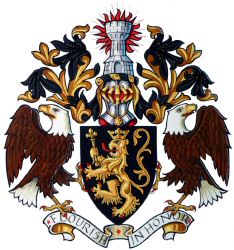
The armorial bearings of the College are a classic example of one of my favorite quotes from von Volborth:
"Try to keep the design as simple as possible. Arms are still meant to be means of identification and representation and should be easily recognized and remembered. Crowded designs do not answer to this condition."
- THE ART OF HERALDRY (Carl-Alexander von Volborth, Blandford Press, Dorset, 1987)
 Would
that all potential registrants with our organization heeded that
admonition. As it is, we are often confronted with proposed designs
laden with numerous elements and colors. Such designs are not only
confusing, and lose all definition
when reduced for reproduction in publications, but they can be
downright unattractive.
Would
that all potential registrants with our organization heeded that
admonition. As it is, we are often confronted with proposed designs
laden with numerous elements and colors. Such designs are not only
confusing, and lose all definition
when reduced for reproduction in publications, but they can be
downright unattractive.
When I have been granted the honor of teaching 6th graders an hour's course in basic heraldry, I often begin the talk by pointing out that heraldry is not a dried up pile of dusty books in the reference section of their library - heraldry is, in fact, seen every day of their life. I then proceed to show them heraldry on automobiles, on buildings, in stained glass windows, and in their favorite movies (Harry Potter, Monty Python and the Holy Grail, The Chronicles of Narnia, even the Twilight series).
But an even more rudimentary example of heraldry is exemplified by an unexpected source.
My first question to the students is "How do you tell the teams apart on the basketball court, the baseball diamond, the football field, etc?" Naturally, the respond with "By the color of their uniforms!" "So," I say, "how do you think that medieval knights knew who their enemy was on the field of battle?," to which a few bold students sheepishly reply "...by...their...uniforms?" Precisely.
Now granted, everyone wasn't running about luxuriously resplendent in matching tunics and armor - that's saved for Tony Curtis and Robert Wagner epics. Only a handful of knights on a field of battle actually could afford to (or were entitled to) wear their colors. But you get the point. The guys in blue fought on one side, the guys in red fought on the other. You knew from a reasonable distant glance who to stab and who to protect. And that is the main point of heraldry - EASY identification.
If you have to get close enough to an individual to see that the twelve lions on his shield are facing one way, instead of the other, you're probably close enough to get a sword in the gut. In the case of the football analogy, you'd throw an interception.
And thus we circle back to the original point - a coat of arms is not meant to be filled from edge to edge with as many shapes and elements as you can fit. As the saying goes, less is more. Some of the most beautiful armorial achievements throughout history have been extremely simple in design. There are an infinite number of combinations of colors and elements possible in heraldic design.
An oft-asked question is "But how can I display all of my interests if I don't include something for each one of them? I'm in the army, I like reading, I ride horses, I'm really into birdwatching, my ancestry is Hungarian and Danish, and I have 12 children. I need to show all of that in my coat of arms." No, you don't.
Keep it simple. Don't over-divide. Don't quarter. Don't use more than 3 different elements in your shield - the more elements in your shield, the smaller each will have to be to fit, and thus the more minute they will be when added to your letterhead, reproduced in heraldic journals, etc. While a coat of arms should reflect your likes and interests, it is not intended as a thorough autobiographical display.
Take a look at the arms of the College - extremely simple, yet exquisite in their design. And that design will hold up for centuries. It has one main element - a lion - with a couple of minor additions that separate it from other pre-existing lion shields. The same can be done with innumerable other design elements.
See elsewhere on this page for more recommendations from von Volborth - the man knew what he was talking about.
"I have a very specific visualization of my arms, and want to work with your artist to have him/her draw it exactly as I want it to appear."
The College works with individuals to design their proposed armorial bearings, usually through a give and take process enabled by clipart "sketches" of the arms, meant to fine-tune the final design to an achievement which is both heraldically "correct" and which satisfies the armiger's requests as best as possible. Once a final design is established, and the armiger approves same, said design is forwarded to our artist for rendering. The artist then renders a black and white lineart version of the blazon in his/her own style - accurate to the blazon but in the artist's own unique style. The College then digitally colors the rendering for inclusion in the registration certificate - this is obviously not the same as a library painting version of the arms, which can easily (and justifiably) run to $1000 or more, depending on the artist.
The armiger does not work with the artist during this process - if the College were to allow for a "back and forth" between armiger and artist, the process would be much-protracted and would most certainly cost a great deal more than what our organization currently charges for a registration of arms. There are a number of artists listed on our website, and you may wish to contact several of them to get quotes on whatever level of rendering you prefer.
The potential armiger must understand that the College (or any other heraldic body for that matter) is registering a BLAZON, and not a drawing. An heraldic artist visually interprets a textual blazon, and there are an infinite number of ways to render the same blazon - all may be correct, but all may be different. An example of this may be seen in the current Executive Director's own arms, rendered by numerous international heraldists through the years (drw.9august.com). Once an armiger registers arms with the College, he/she may certainly independently commission an artist, or artists, to render his/her arms in a very specific manner, designating exacting colors, minutiae, etc.
What about all those places I see where I can get my coat of arms and/or family name history?
We haven't seen a better answer to this question - and what you can do about it - than that shown on the National Genealogical Society's website - http://www.ngsgenealogy.org/
-
Read the offer carefully. Then--think twice.
-
Was the letter you received also sent to thousands of other people with the same last name?
-
Do you know many people who can afford to print and mail thousands of letters to sell a book on their family history?
-
Does the letter offer a family history, or....
-
Does it merely offer a list of addresses of people who have your surname, suggesting that you write to them to learn about your ancestry?
-
Does the advertisement offer a coat of arms for your last name? Coats of arms were first granted to individuals--not to surnames. Then, as now, the right to use these arms was inherited from one's father.
-
How could a company that has not researched your family tree know whether you have inherited the right to display a particular coat of arms?
-
If you ordered it by mail, you can return it for a refund.
-
Be sure to enclose your name and address, as well as a statement that you request a refund.
-
At the Post Office, you should buy a "return receipt for merchandise."
-
If you paid for the product by credit card, ask your card company for help getting a credit.
-
If you have not received a refund within six weeks, call The National Consumers League at (800) 876-7060 (10:00 A.M.. to 5:00 P.M. EST) for advice. Or, you can write to them at:
-
Keep a file on products that misrepresent genealogy and heraldry
-
Contact the consumer news columnist of your newspaper, suggesting that he or she feature an article on this topic.
-
Sponsor a program on surname solicitations. Ask your members who have purchased surname products to give a short talk on their experiences.
-
Offer to speak to local service clubs about products masquerading as genealogy. You will not have to worry about libel if you stick to the facts and avoid specific name calling.
-
Encourage your community college to offer courses on genealogical research methods.
PSST! Wanna Buy Your Name?
Don't Let Them Take Your Name in Vain!
A variety of companies sell mass-produced items for thousands of surnames. Among these are one-page "surname histories," products showing a coat of arms, and books that feature addresses of individuals who share the same last name. These items are offered by direct mail, sold in airports and shopping malls, and advertised in magazines.
Millions of people buy these products, hoping they will learn something about their own family histories. However, people with the same last name do not necessarily belong to the same family or share ancestors. Those who suggest that a mass-produced item is part of a customer's individual family background are misrepresenting genealogy and family history. The National Genealogical Society and the Federation of Genealogical Societies believe that there are four things you can--and should--do when you encounter any of these products.
1. Be Alert!
2. Return It!
If you bought a surname product that you realize has nothing to do with you or your family, you have the right to return it for a refund. Here's how to do that:
National Consumers League
81515th Street, NW
Washington, DC 20005
3. Complain!
It is illegal to conduct schemes or devices to obtain money through the U.S. mails by means of false representation. The legal citation is 39 U.S.C.93005. The U.S. Postal Inspection Service will investigate any companies that use the U.S. mails to misrepresent mass-produced surname books or coats of arms. But the Service needs to hear from you before it can take action! If you receive a solicitation that you believe misrepresents the product being offered, you should write to the Consumer Protection Division, describing the ways in which you believe the company that contacted you has engaged in false advertising. If you don't have time to write, simply replace the contents in the envelope, reseal it, and cross out your name and address. Then, forward it to:
U.S. Postal Inspection Service
Consumer Protection Division
475 L'Enfant Plaza, SW
Washington, DC 20260-1100
4. Tell Others!
It is important to let others know what genealogy is....and what it is not! Here are some ideas for your society to use:
As a woman, do I have to display my armorial bearings on a lozenge?
The short answer is no. Female registrants may choose to register the arms on either a lozenge, oval, or cartouche, or as a "full" armorial achievement (to include shield, helm, torse, mantling, and crest).
When armorial bearings had a utilitarian purpose, the shield was part of the armor of a knight, and (at the time) it was obviously "improper" for the feminine sex to use armor. A woman would also not display either a helmet, a crest, or the mantling of a traditionally-male achievement. Why? The crest was to aid in identifying a knight in battle when his helmet concealed his face. A woman did not go into battle - she did not wear a helmet, and therefore needed no such identification. The mantling, which represented another portion of a knight's equipment, was also considered inappropriate for the use of women.
Even though centuries have passed since the original "rules" of heraldry were set down, there are still countries and heraldic entities that hold fast to the lozenge-for-women display.
In Canadian heraldry, women and men are treated equally for heraldic purposes, as required by Canadian equality laws. It is therefore common to display the arms of women on shields, rather than on a lozenge or oval, but a woman may still choose to have her arms displayed on a traditional shape. The Canadian Heraldic Authority has even gone so far as to designate a set of cadency marks for daughters, similar to those used in English heraldry for sons (see below). In Scotland and Ireland, women may, under certain circumstances, be permitted to display their arms on a shield.
In this country, given the fact that women are equally entitled to serve in the United States military services, they obviously have an equal right to the full display of a knight's achievement. Thus, the American College of Heraldry offers female armigers the option of either a "full" achievement, or display of arms on a lozenge, oval, or cartouche.
What heraldic "augmentations" will the College register?
The heraldic traditions of various nations typically employ a variety of additions or augmentations to denote special status, such as nobility, or personal achievement. Since the American College of Heraldry is an American institution, it values these heraldic traditions and understands that individual armigers may employ various systems of augmentation and cadency as they are relevant to their own heraldic and/or genealogical heritage.
However, because the American College of Heraldry operates in the context of a republic, and because titles of nobility or other distinctions of social class are absent from the American political and social structure, the College will normally register only the core elements of an heraldic achievement which do not denote specific status. These are the shield of arms, the crest, and the livery colors (i.e., the colors depicted in the mantling and wreath of the achievement).
Some notes concerning specific elements:
The Shield
The shield will be registered in its undifferenced form, absent of any marks of augmentation or additions. For example, some chivalric orders allow a ‘chief of religion’ to be added to an armiger’s shield, and while displaying the arms in this way is perfectly acceptable, the College will register only the arms of the individual without the augmentation.
The Crest
The crest will be registered without augmentations of honor. Normally, these are not applied to the crest itself, but on occasion, crests have been augmented with charges from the arms of a chivalric order, or altered in some way to reflect elevated status. The College will only register the undifferenced version of the crest.
The Helm
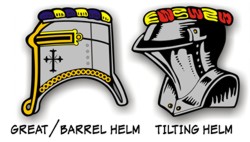 There
are certain "rules" that apply to the use of the helm in heraldry, and
while (as with other "rules of heraldry") these are not necessarily
hard and fast, the College does follow these basic tenets:
There
are certain "rules" that apply to the use of the helm in heraldry, and
while (as with other "rules of heraldry") these are not necessarily
hard and fast, the College does follow these basic tenets:
- The Helmet assigned to Kings and Princes of the Blood Royal, is full-faced, composed of gold, with the beauvoir divided by six projecting bars, and lined with crimson.
- The Helmet of the Nobility is of steel, with five bars of gold: it is placed on the shield inclining to a profile.
- The Helmet of Knights and Baronets is the full-faced steel helmet, with the visor thrown back, and without bars.
- The Helmet of Esquires, always depicted in profile, is of steel, with the visor closed.
The traditional helms for registration with the College are the Tilting Helm or the Great/Barrel Helm (denoting "Esquire" rank), examples of which may be seen on our Registrations page.
Motto
The motto, typically depicted on a scroll either below or above the overall achievement of arms, will not be registered by the College - however, it may appear in the drawing of the Arms - it simply won't be included in the blazon. Mottos are frequently changed by families or different branches of families, and may be depicted in any language appropriate to the armiger's heritage or preference. Click here for further details about mottoes.
The Livery Colors
The livery colors (generally the principal tinctures of the shield) will be registered, typically as the colors applied to the mantling and wreath. In some cases, the colors of the mantling are not the same as those of the principal shield tinctures (e.g., Archer-Shee bears mantling Gules and Argent, while the principal tinctures of the shield are Or and Azure).
In achievements of nobles in some traditions, the arms are often displayed within a robe of state or rank (often doubled Ermine). Such robes will not be part of individual registrations with the College, and neither will compartments or other elements that may be interpreted as functioning as supporters (see below).
A frequent augmentation of honor is the addition of supporters, either persons, objects, or heraldic beasts on one or both sides of the shield. These virtually always indicate nobility, and will not be registered for individuals by the College. The arms of organizations, however, may be depicted with supporters, and these may be recorded by the College as a simple matter of documentation where no indication of special status is conferred upon the organization or to members of that organization.
Certain chivalric or religious orders allow the shield to be surmounted on a distinctive cross or other device pertaining to the order. Such devices will not be part of a registration with the College. All other devices or symbols of official status (batons, scepters, keys, etc.) which may be depicted surrounding or behind the shield of arms are also excluded from registration.
Coronets of Rank and Ecclesiastical Hats or Crowns
Coronets of rank indicating noble status or title are specifically excluded from registrations by the College. The College does not preclude the use of such coronets in the depiction of arms as appropriately used by individual armigers, but cautions that such coronets are not relevant in an American context and their use may be seen as extravagant or inappropriate by other armigers.
Ecclesiastical hats or crowns indicating status as an ordained minister, priest, bishop, or other member of the clergy in any religious tradition are only registered by the College after review by the Board of Governors for appropriateness. As with all other augmentations, these may be depicted independently as appropriate according to the individual armiger’s preference.
Badges and Insignia of Military Honors, Orders or other Organizations
Badges or insignia of chivalric orders, hereditary societies, military honors, etc. will not be registered by the College as part of an heraldic achievement. These may, of course, be depicted in the armiger’s achievement of arms (independent from the actual registration recorded by the College) as per his or her prerogative in accordance with appropriate guidelines as issued by the relevant order or body.
Other Augmentations
All other augmentations, badges, enhancements, or differencing (including marks of cadency) not specifically addressed in the points above will not be registered by the American College of Heraldry.
"How does your organization ensure that the arms I design/register don't conflict with existing armorial bearings granted to someone else?"
This question is often asked, and there is no hard and fast answer. As the reader is aware, there are many coats of arms bearing considerable similarity borne by families that are not in any way related. Thus, we may be certain that similarity, while a potential point of confusion, does not in and of itself violate the spirit of coat armor. It must be maintained that only if identical arms are assumed or appropriate are the rights of the first armiger truly violated. This is precisely the reason for the existence of many “ordinaries of arms” cataloging arms by the similarities of their divisions and/or principal charges. Clearly, in some cases, these arms are of related families (e.g., the shields of Clare and related families showing the familiar chevrons in the mid-sixteenth century Flower’s Ordinary in the College of Arms), but just as frequently, we encounter ordinaries of arms documented unrelated families with similar arms (e.g., the many arms showing garbs as a principal charge in the 1599 Book of Sutes or Ordinaries of William Smith, Rouge Dragon Pursuivant).
The College further points out that no office of arms, whether official, or a private society such as our own, has the resources or the mandate to complete an absolutely exhaustive search of all arms that are, or have been, employed in any and all heraldic jurisdictions, before making a grant or registration. It is expected that a review of the records within the specific heraldic jurisdiction, along with the officer of arms’ personal knowledge of heraldry, will be sufficient to avoid treading upon other arms in that jurisdiction. Of course, avoiding a duplication of arms from another jurisdiction is highly desirable, but this does not fall within the mandate of any individual office of arms, except in avoiding allusion to foreign arms that are well-known and therefore obvious.
With that said, the College certainly appreciates that the very purpose of arms is to provide unique identification to an armiger and his or her descendants. In that respect, bearing arms that are easily confused with those of another armigerous family is not a desirable situation.
In the United States, as this nation is a blend of diverse traditions and cultures, such a review would be difficult even by a governmental agency with substantial resources. For a private society, it is wholly impossible. We cannot guarantee that such unintentional references to foreign arms might again occur, but we shall be circumspect and earnest in our efforts to both avoid them, and to mitigate them if the should occur.
So far as we know, there is no exhaustive listing of international Arms anywhere in the world, despite the existence of some very excellent collections. Arms have existed in all or most of the nations of Western and Eastern Europe, as well as in many nations throughout the world. From the early heraldic period, some Arms have been "official," that is, granted or in some way recognized by a sovereign person or nation. However, "assumed," or unofficial Arms have also long existed in many nations. In more recent times, these have often been recorded in local archives, by heraldic societies, or in various heraldic texts. Some nations are solely concerned with the recording and protection of official Arms and citizens who wish to bear unofficial Arms are free to do so. As a result, many thousands, if not millions, of Arms have been created and used during the last 1000 years.
It is a well recorded fact that identical Arms have been borne by distinguished though unrelated families in different nations. Naturally, this is not an ideal situation. So far as we know, there has been no meaningful attempt to create an exhaustive international archive of Arms, though there are several excellent international texts. This likely could only be done with a computer since the task is so large. However, we are told that those who have attempted movement in this direction have met with very significant technical difficulties. Were such a computer based archive to be successful in recording international armory, it would surely be most useful.
Were we to learn that we had duplicated and registered an earlier design, we would, naturally, cancel the registration and create a new design for the person. We would also openly discuss the matter in our quarterly journal.
The American College of Heraldry will, to the best of its ability, attempt to avoid unintentional similarities and allusions in the arms it registers, but recognizes that the nature of modern heraldry, even with its growing palette of charges and designs, operates according to a somewhat limited set of conventions and rules. Within any regulated symbolic system, even one as flexible as heraldry, similarities cannot entirely be avoided.
|
TYPICAL ACH REGISTRATION ARMS (click to enlarge) This illustration reflects armorial bearings that would be registerable with the College. Not included in such a registration - designed with the College as opposed to one granted by some other heraldic authority - would be such items as robes of estate, barred or front-facing helms, supporters, compartments, or crowns/coronets. |
)
"I have designed an extensive set of armorial bearings, including the complete shield, mantling, helm, crest, robe of estate, supporters, and compartment. I can just send these to you and you will register them as-is, right?"
In short, no. The College receives numerous applications for registrations monthly, and perhaps to-a-registration, some form of modification will have to be made to make the bearings either 1) heraldically correct, or 2) conform to the College's standard registration policies. Of chief concern is the desire of an individual to register anew supporters, surmount the arms upon a robe of estate, or the overall achievement placed upon a compartment. The College's policy in such matters is to only include such elements in a registration of armorial bearings if said items have actually been granted by a sovereign entity and/or by its heraldic authority. The College will neither register "adopted" supporters, nor place the arms atop a robe/mantle of estate, unless they have been previously granted. The College's "typical template" would be that of the shield, surmounted by the Tilting or Great Helm. Thereupon would appear the appropriate mantling and torse, with crest thereabove. While the College does not register mottos per se, they may be included in the final rendering of the Armorial Bearings.
"Why can't I use any combination of colors that I want in my arms?"
One of the basic "tenets" of heraldry is - "no color on color, no metal on metal." Fairly self-explanatory, it simply means that a metal charge cannot be placed on a metal field, nor a color/tincture charge placed atop a color/tincture field. Of course, as with any rule, there have always been exceptions.
Again quoting from the rec.heraldry FAQ:
The "colours" used on shields are strictly called tinctures; there is a limited range which varies somewhat from place to place and time to time. These tinctures are divided into two groups: gold and silver, which are called the metals, and all the others, which are called the colours.
In Woodward's words, it is a "primary heraldic canon" that colour is not placed on colour, nor metal on metal. This rule was used to ensure that coats of arms could be easily recognised at a distance or in the heat of battle.
It is commonly said that the arms of Jerusalem (Argent, a cross potent between four crosses Or) are the only counterexample. However, Woodward quotes several examples from continental heraldry in which the "rule" is broken: e.g. Grasse (Azure, ten stars Gules, 1, 2, 3 and 4) and Doro (Argent, a lion Or). Augmentations of honour sometimes breach the rule as well, and a chief of colour is often, especially in continental heraldry, placed on top of a simpler coat, giving an appearance of colour on colour.
What is certain is that colour on colour or metal on metal is exceedingly uncommon or non-existent in English, French and Scottish heraldry, and that the Kings of Arms in Scotland and England would not grant such an arrangement today.
In other countries the rule is less rigidly followed, and in some, such as Hungary, colour on colour is very common. Most of the books in English reflect English or Scottish heraldic practice and ignore the heraldry of other nations.
Another source details some of the exceptions to this rule:
- First, what the French call armes pour enquerir, or armes à enquerre, as the insignia of the kingdom of Jerusalem, where gold appears on silver; and in other cases where colour appears on colour, e.g.
- Secondly, the rule does not extend to chiefs, cantons, and bordures, which, however, are in such cases by some heralds represented as cousu, i.e. giving the idea of the charge being sewed to, and not laid upon, the field. Marks of cadency also, such as labels, bendlets, and batons are exempt from the rule.
- The third exception is of a party-coloured field (as quarterly, gyronny, barry, checquy, vair, etc.), which may receive a charge either of metal or colour indifferently, and vice versa.
- The fourth is, when charges are borne of their natural colour, not being one of the recognised tinctures of heraldry. Such charges are nevertheless generally placed upon a field of a contrasted tincture.
- The fifth and last exception, and the most frequent case to which this rule does not extend, is when animals are armed, attired, unguled, crowned, or chained of a tincture different from that of their bodies.
"The Court of The Lord Lyon protects arms granted in Scotland, The College of Arms protects arms granted in the UK - how can I protect arms registered with the College (or any other US entity)? Can I trademark or copyright them?"
Unfortunately, there is no way to legally protect a coat of arms in this country. I would refer you to a brief article on the subject - http://commons.wikimedia.org/wiki/Commons:Coat_of_Arms. An abridged explanation:
- The Coat of Arms definition is made of words [blazon] - for instance, "Per fess argent and vert, a dragon passant gules".
- The Coat of Arms representation is a picture/rendering, which can be drawn/painted by any heraldic artist.
Two very different things are involved in a Coat of Arms.
Both the definition and the representation of a Coat of Arms are intellectual creations, and their legal protection may be considered as such.
There are various reasons why the description usually can't be copyrighted: it is often a legal production, most of the time a very old creation, there is little artistic creativity in it, and it is an abstraction, not a definite realisation. The fundamental reason is that definitions are not subject to intellectual property rights, anyway.
To be sure, some Coat of Arms definitions indeed claim copyright, but this is very rare. Furthermore, there is little chance for such a claim to stand in court if the claim is indeed on the definition part (whereas if the claim is made on the representation, it is obviously valid).
This means that anybody can draw a new coat of arms from a definition without copyright constraints: the "derivative work" notion simply doesn't apply in that case.
This also means that a Coat of Arms inspired from another (found on the net), with the same composition, but with a different interpretation, is not a "derivative work": When a new Coat of Arms picture is made, it is a "derivative" of the (PD) description, not of the website's (copyrighted) image, hence the copyright regime is simply that of a self-made picture.
As to copyright, you could certainly copyright the blazon, but that would not impact someone drawing the arms and displaying them.
You could apply for a trademark, but that would only be for a specific rendering of a coat of arms, and not ALL renderings of that coat of arms.
So, the long and short of it is, there is no legal protection in this country.
"If I decide to have armorial bearings registered with the College, how long does it take?"
One of the most commonly asked questions, and quite reasonable. The answer depends on several factors:
-
If you already have arms either granted to you by an existing heraldic entity (e.g., The College of Arms), then the registration process with our organization merely involves the commissioning of one of our own heraldic artists to faithfully reproduce the existing grant for use in our own paperwork/documents.
-
If you choose to have new armorial bearings registered with the College, and have already finalized a design of your own (and it meets our basic principles of heraldic design), then again we would commission one of our own heraldic artists to faithfully reproduce the finalized design for use in our own paperwork/documents.
-
If you have only a vague idea of what elements should comprise your new armorial bearings, or in fact none at all, then the process would involve an initial review of all paperwork you submit (and it is important that you provide all information contained on the registration application form, along with any other relevant personal/family information you feel might assist the College in designing arms appropriate for your particular situation). This would then lead into a back and forth process, either by email, facsimile, or post, to fine tune the design to your exact preferences - again, within basic principles of heraldic design. Once the final design is approved, we would then commission one of our own heraldic artists to render the new armorial bearings for use in our own paperwork/documents.
How long does it take for a given artist to produce the rendering of your armorial bearings? This all depends on the current workload of that artist, as well as the complexity of the design in question, but you should usually allow 4-6 weeks from the time we commission the work until it is received back in our hands.
Once the commissioned artwork is received by the College, it is then colored and added to the Registration document. The final Registration, along with a black and white version of the armorial bearings for the armiger's own use, are sent to the armiger. This final stage can usually take place fairly quickly, but again may be protracted by the then-current number of registrations in process.
"My one question as a genealogist is, 'How do you design a coat of arms?"' (thanks to Keith D. Ashley)
Based on several such questions, we include herebelow an unabridged quotation from The Art of Heraldry (Carl-Alexander von Volborth, Blandford Press, Dorset, 1987, p. 218) for those who wish to design their own armorial bearings.
- Make sure that the design is unique and does not infringe upon the rights of others. A coat of arms is personal property, and to have the same or a similar name as an armiger does not mean that one is necessarily related to him and entitled to his arms or a version thereof. If your father's brother, for instance, assumed a coat of arms, this does not mean that you are entitled to use it, unless he made the necessary provisions. If one cannot prove genealogically to descend from an armiger in the male line, he cannot use his arms.
-
Try to keep the design as simple as possible. Arms are still meant to be means of identification and representation and should be easily recognized and remembered. Crowded designs do not answer to this condition.
-
Respect the ethnic background of your family and try to keep the new arms in the style of the country of your origin. If you are, for example, an American citizen, having a German or a French name, don't use the heraldic style and charges which are characteristic for British or Italian heraldry.
-
Do not use badges of Orders of Chivalry as charges for your arms. This can be misleading. Should you be a member of such an order, you can show this outside the actual coat of arms.
-
Do not use coronets, crowns or any other object that may have a particular meaning in the heraldry of the historical noblesse. Do not use supporters, they have a particular significance in heraldry and should not be assumed. Avoid everything that could be interpreted as misleading.
-
In your choice of charges you might search for symbols which express perhaps an occupation or profession that was or is characteristic for members of your family, for a pun on your name (canting arms) or for something relating to the place of origin of your family. There are innumerable possibilities to create a meaningful coat of arms. As for the tinctures you could use your favourite colour combination (preferably limited to one colour and one metal ) or the colours of your home town or country. Charges like the rod of Aesculapius for physicians or the Caduceus for merchants for example have been used only too often and are not very original. Try to avoid heraldic platitudes in a new design. A sailor does not have to use a whole ship. Oars, a sail, a boat or a rudder would do the trick, and artisans could use the tools of their trade, preferably in their medieval form. Show the elements on the shield from the most recognizable angle; a hand seen from the side is meaningless, but palm outwards with space between the fingers is instantly identified.
DESIGN OF NEW
ARMORIAL BEARINGS
IN COUNTRIES IN which armorial bearings can be freely assumed
(this excludes England, Scotland, Ireland, Spain and South Africa)
the following points should be taken into consideration.
These are but a few suggestions. At any rate, it is advisable for anybody wanting to assume a coat of arms to consult an experienced and reputable heraldist.
"I've seen black and white renderings of armorial bearings with all sorts of diagonal lines or dots. What are these?"
) According to Grand Larousse Illustré du XXe sie`cle
(1932), the method was named after his inventor. The Jesuit and
heraldist Silvestre Petra Sancta, or Pietra Santa (Roma, 1590 - Roma,
1647) was rector of the college of Loreto. Later, he settled in Roma
and published there two famous treaties of heraldry (in Latin): Blazons and emblems of
nobility (1634) ; Coat of Arms of the Great Famlies (1638).
According to Grand Larousse Illustré du XXe sie`cle
(1932), the method was named after his inventor. The Jesuit and
heraldist Silvestre Petra Sancta, or Pietra Santa (Roma, 1590 - Roma,
1647) was rector of the college of Loreto. Later, he settled in Roma
and published there two famous treaties of heraldry (in Latin): Blazons and emblems of
nobility (1634) ; Coat of Arms of the Great Famlies (1638).
Ottfreid Neubecker states that Petra Sancta did not invent the method, but popularized it in his second treaty (Tesserae Gentilitiae). Petra Sancta also proposed new elements of the external decoration (around the shield) for princely arms, i.e. mantle for dukes and sovereign princes, and pavilion for emperors and kings. In the latter case, Petra Sancta modeled the pavilion after tents (which could be dismantled) used at the time by princes. His sources were the engravings by L. Gaultier for Tableau des Armoiries de France (Table of Arms of France) by Philippe Moreau (1609 and 1630) and Histoire de la Maison de France (History of the House of France) by the brothers Sainte-Marthe (1628).
|
ARGENT |
SILVER/WHITE |
EMPTY/BLANK |
|
OR |
GOLD/YELLOW |
POINTS/DOTS |
|
GULES |
RED |
VERTICAL LINES |
|
AZURE |
BLUE |
HORIZONTAL LINES |
|
SABLE |
BLACK |
VERTICAL AND HORIZONTAL LINES |
|
VERT |
GREEN |
DIAGONAL LINES FROM DEXTER TO SINISTER |
|
PURPURE |
PURPLE |
DIAGONAL LINES FROM SINISTER TO DEXTER |
|
MURREY* |
MULBERRY |
DIAGONAL LINES FROM DEXTER AND SINISTER |
|
TENNÉ* |
ORANGE |
DIAGONAL LINES FROM SINISTER TO DEXTER AND HORIZONTAL LINES |
|
SANGUINE |
BLOOD RED |
DIAGONAL LINES FROM DEXTER TO SINISTER AND HORIZONTAL LINES |
|
MARRON* |
BROWN |
CROSSING BENDWISE AND PALEWISE (NOT SHOWN IN GRAPHIC) |
|
CENDRÉE* |
GREY |
CROSSING BEND SINISTER AND PALEWISE (NOT SHOWN IN GRAPHIC) |
* SELDOM USED
"I want my arms to have a specific shade of blue (or red, or green, etc.). How do I blazon that?"
Quite often we are asked to "make sure the blue in my arms is exactly Pantone 293C" (or some specific description). Aside from the specific colors mentioned hereabove (and a few additional odd exceptions), there is no system for defining a particular shade of any given color when rendering arms.
The colors used in heraldry are never precisely defined as to specific hue of that color, just so long as that color is clearly identifiable at a single glance. J. P. Brooke-Little, in his book Boutelle’s Heraldry says: "While the colours of heraldry are usually rich, they may vary as to shade within reasonable limits. No exact meaning attaches to the words gules, azure, etc."
Thus, while the blazon may simply describe something as Azure, the armiger may specify to the artist painting his/her arms a preference for a particular shade of blue - provided it is within reason.
"I want to register arms for myself, my father, my mother, my brothers... What do I do?"
Many individuals initially contact our organization requesting armorial registration for themselves, and then revise their request to include other siblings, or even parents. Before you spend time completing our application for registration, consider exactly what you wish to accomplish.
If you want to register armorial bearings for all of your siblings, you would most likely register the arms in the name of your father, thus making all his descendants ultimately eligible to bear the same arms. In this instance it should be noted that the College would issue one registration document for the father, and not multiple copies of the same document for all registrants. Additional copies of this registration document would be available for a modest additional fee, but they would not be altered in any way from the original registration document.
To accomplish this, you would complete the registration application in the name of your father, completing all of his pertinent information (biographical, education, children, grandchildren, hobbies, affiliations, etc).
If, however you wish to have you own armorial bearings, different from those of, say, your father or your brother or sister, then you would complete separate registration applications, and pay individual registration fees.
"Can the College help me obtain a grant of arms from Spain (or elsewhere)?"
If you wish to get arms recognized and protected by the State, Spain is (unfortunately) no longer the place to go.
With the death of the last National Chronista Rey de Armas, H. E. Don Vicente de Cadenas y Vicent on 21 December 2005 we believe this window of opportunity to be closed. There is no indication H.M. the King is planning to name a replacement at this time.
Under the Spanish decrees of 1915 and 1951, in order to make their certifications of arms legally recognized by the Spanish government, to afford government protection to the rightful owner of arms in the certification and to insure that Chronistas did not abuse their position as heralds in the issuance of certifications as to heraldic and nobiliary matters, Chronistas were required to have all their certifications viewed, countersigned, dated and sealed by a Sub-Secretary of the Ministry of Justice.
Without the Countersignature, Date and Seal of a Sub-Secretary of the Ministry of Justice, therefore, a certification of personal arms in our opinion has no legal governmental significance or protection. In other words, the document is merely the private certification of a devisal of the Chronista to an individual.
Any replacement, in our opinion, of the Countersignature, Date and Seal of a Sub-Secretary of the Ministry of Justice in the certification with the signature, date and seal of a notary public, even a government notary public, or a series of notary publics, no matter how colorful and fancy, does not make the certification a valid document, but merely a fancier version of the private certification of a devisal of the Chronista to an individual.
As far as we are aware every Certification of arms issued by Don Vicente had the proper Countersignature, Date and Seal of a Sub-Secretary of the Ministry of Justice, and therefore his certifications are legal government documents affording protection to the armiger and recognition of the Kingdom of Spain.
Then there is a regional Chronista de Armas, Don Alfonso de Celallos-Escalera y Gila, Marqués de la Floresta, appointed to his position by the Junta of Castille and Leon about 1991. He is the only regional Chronista we are aware of at this time. His powers as a regional Chronista were circumscribed by the Council of State of the Kingdom of Spain at a meeting in 1995 which stated that he was only to advise community governments on matters of provincial, municipal heraldry and vexillology and to issue arms to communities on behalf of the Junta of Castille and Leon. The Marqués de la Floresta was informed in 1995 he had no authority from the Ministry of Justice to issue certifications of personal arms. Therefore it can be understood why the Ministry of Justice would no longer countersign and make legal his personal certifications. It is to be hoped the regional Chronista is informing his clients of the private status and nature of his certifications of arms to them.
There is always an exception to the rule. In a very few cases where H.M. the King has ennobled with a title of nobility and arms, he has on occasion used the Marqués de la Floresta to issue the Certification of nobility and arms to the ennobled person and then personally countersigned the certification manually in his own royal hand. We have been told the King did this as a friendly souvenir gesture to the friend he ennobled but without doubt it also served to make the certification official and legal. We also believe H.M. the King could have ennobled his friend on the back of a napkin with hand drawn B&W tricked arms signed and dated it and it would be a legal document officially recognized by the government etc.
-
Contributed by Dwyer Wedvick, Brookfield, CT
"I am a first son, and I want to register my father's arms and then show my own arms with a mark of cadency, and then my own sons' arms with their marks of cadency. Do you do this?"
The short answer here is - no. We produce a single armorial registration document, with one rendering of the achievement by one of our artists - the registration is for a single individual and his descendants. If additional copies of the same registration are requested, they are available for a modest additional fee.
A further reason for this restriction is that a mark of cadency is intended as temporary - it exists during the original armiger's lifetime, and must be modified on that individual's passing.
However, as we often receive this question, and individuals may certainly apply additional marks to the rendering they receive from our organization, we include here a brief explanation of marks of cadency.
Cadency marks, also referred to as distinctions, differences, or marks of cadency, are used in heraldry to indicate by its addition to an armorial the birth order of a male heir. The cadency mark has been traditionally used to differentiate between different branches of a family which bear the same arms, and generally appears in the center chief of the shield. While the use of cadency marks does at times occur in Continental European heraldry, it is much more often found in British heraldry (i.e., English, Scottish, Irish, or Welsh).
There is also apparently no color restriction on marks of cadency, as they tend to adhere to the tinctures/metals of the original shield itself.
Although the emblems given here are the most common cadency marks, they are not the only way in which generations and branches of families have been distinguished from each other. The bordure has been used as a cadency mark in both Scotland and England. In England the bordure as a difference only indicated that the bearer of the arms was not the head of the family. However, in Scotland the lines of partition are used to indicate birth order, much as the emblems below are used in English arms.
|
|
|
|
|
|
|
1ST SON Label of 3 points* |
2ND SON Crescent, points up |
3RD SON Mullet |
4TH SON Martlet |
5TH SON Annulet |
)
)
)
)
)
|
|
|
|
| |
|
6TH SON Fleur-de-lis |
7TH SON Rose |
8TH SON Cross Moline |
9TH SON Double Quatrefoil | |
)
)
)
)
* This label is removed on the death of the father, and the son inherits the plain coat
Arms are generally the property of their owner from birth. In other words, it is not necessary to wait for the death of the previous generation before arms are inherited.
The eldest son of an eldest son uses a label of five points. Other grandchildren combine the brisure of their father with the relevant brisure of their own, which would in a short number of generations lead to confusion (because it allows an uncle and nephew to have the same cadency mark) and complexity (because of an accumulation of cadency marks to show, for example, the fifth son of a third son of a second son). However, in practice cadency marks are not much used in England and, even when they are, it is rare to see more than one or, at most, two of them on a coat of arms.
Although textbooks on heraldry (and articles like this one) always agree on the English system of cadency set out above, most heraldic examples (whether on old bookplates, church monuments, silver and the like) ignore cadency marks altogether. Nor have they often been insisted upon by the College of Arms (the heraldic authority for England and Wales). For example, the College of Arms website (as of January 2005), far from insisting on any doctrine of "One man one coat" suggested by some academic writers, says: "The arms of a man pass equally to all his legitimate children, irrespective of their order of birth." It then says "Cadency marks may be used to identify the arms of brothers, in a system said to have been invented by John Writhe, Garter, in about 1500." It does not say that they MUST be used.
The system is very different in Scotland, where every user of a coat of arms is meant to have a personal variation appropriate to that person's position in their family approved (or "matriculated") by the Lord Lyon (the heraldic authority for Scotland). Scotland, however, uses a different system for this which typically applies a distinctive "bordure" to the basic design of arms rather than the English cadency marks. However, Scotland, like England, uses the label of three points for the eldest son and a label of five points for the eldest son of the eldest son, and allows the label to be removed as the bearer of the plain coat dies and the eldest son succeeds. In Scotland (unlike England) the label may be borne by the next male heir to the plain coat even if this is not the son of the bearer of the plain coat (for example, if it is his nephew).
The most recent development in the area of cadency has been developed by the Canadian Heraldic Authority (which allows for descent of arms through both sons and daughters, as does the ACH). Marks of cadency specifically for daughters include:
|
|
|
|
|
|
|
1ST DAUGHTER Heart |
2ND DAUGHTER Ermine Spot |
3RD DAUGHTER Snowflake |
4TH DAUGHTER Fir Twig |
5TH DAUGHTER Chess Rook |
)
)
)
)
)
|
|
|
|
|
|
6TH DAUGHTER Escallop Inverted |
7TH DAUGHTER Harp |
8TH DAUGHTER Buckle |
9TH DAUGHTER Claricord |
)
)
)
)
"I found an old piece of jewelry/furniture/dinnerware with a coat of arms on it - can you help me identify it?"
The College is, unfortunately, unable to assist in such research, owing to our small staff. Our best recommendation here is to post your query on the internet newsgroup rec.heraldry. Be as complete as possible in your description, and offer your email address as a point of contact should someone be able to answer your query.
"I am descended from Charlemagne (or Queen Victoria, or Robert the Bruce - insert your ancestor of choice here). I know that I am a direct male line descendant, and so I want to register those arms in my name."
As stated above, the College is not a research organization, and thus cannot verify with any certainty your claim to a certain genealogical descent. While you may actually be entitled to inherit arms borne by an ancestor, the College is not in a position to study this. Thus, the only "historical" arms we would register would be those granted to you by a recognized heraldic authority (such as the College of Arms, Lord Lyon, etc.).
As you can imagine, there are tens of thousands of possible descendants from any given historical figure (famous or infamous), and there are just as many incorrect or falsified genealogies floating about for every one of them. The College simply cannot "enter the fray" in this area.
"OK, I read everything on the previous page, but I've seen a coat of arms for my family name, and I want to know how to go about registering it..."
Unfortunately, the College is not a research organization, and therefore does not conduct "searches" for surnames or arms.
We have neither the resources nor manpower to search the wide variety of sources listing heraldic registrations, both historic and contemporary, in the U.S. and abroad. While the College endeavors to never intentionally duplicate existing arms from any country, we cannot guarantee such duplication might rarely take place. In all instances where there is not a 100% certainty for proof of descent from an armigerous ancestor, the College strongly recommends the creation of new arms in order to establish a new heraldic tradition within the family.
|
"Petitions for grants of Arms for this title may be made to the Russian College of Heraldry (under the patronage of the Russian Imperial Family) or the American College of Heraldry." Before you fall prey to such sales, CHECK WITH US FIRST to ensure such listed "facts" are true - in most cases they are not. The sellers use our organization's name to lend themselves some sort of undue credibility. |

As you are doubtless aware, coats of arms belong and belonged to specific individuals and their descendants. Thus a given ancestor may have had a coat of arms granted to him, and those arms would then be inherited by his eldest son, and so on, and so on. But no one else in his generation would really be eligible for those arms, nor would anyone else simply having the same surname (this is a very GENERAL explanation, and one to which there are countless exceptions).
If indeed one of your male ancestors inherited a coat of arms from an ancestor to whom they were originally granted, then you are quite fortunate to be the recipient of such an historic tradition. However, others not directly descended from the same ancestor to whom the arms were granted have no connection whatsoever to these arms, or the right to bear them (this is a point of much debate among heraldic researchers worldwide, as geographic and historical borders tend to bend these rules somewhat - not entirely incorrectly given the individual circumstances of the country and time period(s) involved). In fact, they may actually have another ancestor who had arms granted to him, and thus could claim the right to bear an entirely different set of arms. Or, as is unfortunately more often the case, none of your direct ancestors may have been granted arms by a licensed heraldic authority.
The general confusion over who does and who does not have the right to bear arms is the reason so many fly-by-night find-your-name-here "Heraldry" mail-order companies are making money - people simply assume since they have the same surname as an individual who once was granted a coat of arms, they may also claim those arms. I assume you are aware of these general problems in heraldry (if not, you may wish to check out the FAQ found in the rec.heraldry discussion group).
You may find further information on The American College of Heraldry, our history, services, purposes, etc., elsewhere on our home page, the crux of which is to aid those individuals with genuinely granted arms register them in the U.S., or to assist individuals in starting their own heraldic tradition within their family by designing and registering their own unique coat of arms. If you wish to submit a query about the historical armorial bearings of a given individual, we recommend you post such a request on the rec.heraldry discussion group.
"There isn't any OFFICIAL United States Government agency for registering arms in the United States. Who do you people think you are?"
You cannot imagine the frequency with which this question arises, largely from individuals who have not spent the time to learn exactly what The American College of Heraldry does. We are not now, nor ever claimed to be, a GRANTING authority for arms. The College merely serves as a repository for those wishing to REGISTER their arms with an organization dedicated to preserving that heritage. Further, our goal is to aid those who wish to establish their own heraldic tradition create and register new arms. We have also assisted individuals in both creating new arms as well as directing individuals to other international heraldic entities, such as the Court of Lord Lyon, The College of Arms, The Cronista Rey de Armas of the Kingdom of Spain, and the Collegium Heraldicum Russiae to name a few.
The American College of Heraldry is, in simplest terms, a body created to help individuals create and register arms for their own use. Such a registration would not be considered “official” in any other country, simply because it is not a grant of arms from a sovereign agency or government office. Arms registered with our organization are what can be called “assumed” arms, and would be for the individual’s own use. The registration would be published in our quarterly newsletter and our Heraldic Register of America. Most Americans that use our services do so because they wish to create armorial bearings for themselves and their descendants, for their own personal use and satisfaction. If you wished to pursue a grant of arms through a country such as England, Ireland, Scotland, or Spain, you would begin by contacting the heraldic authority in one of those countries and following their procedures. We would be happy to assist in the design process of such a procedure, assuming that, once you received a grant of arms from one of the countries in question, you would then register them with the College. However, registering arms with our organization does not guarantee, or for that matter influence, any other international heraldic authorities will grant arms of such a design.
"If I register armorial bearings with the College, and at some point in the future I change my mind about the design and wish to register new arms, may I do so?"
The College encourages its applicants for armorial registration to seriously consider their final design decision before committing same to registration. We strive to work with a potential armiger to satisfy all of their design requests, and ask them to confirm the final design before the working version is sent to one of our artists to finalize it in ink.
Despite this "admonition," more than one of our past registrants has come back to us requesting either minor modifications to the armorial bearings, or, in some cases, wholly new designs based on either further research into their family history or simply a change is "aesthetics."
Changing arms simply out of a desire for a different design is not something we can accommodate. As you can imagine, there are a number of “Monday Morning Quarterbacks” when it comes to armorial bearings. They register one set of arms, and then as their heraldic interest increases and they have the opportunity to study a broader range of artistic styles, other heraldic designs, etc., they come back and want to modify or wholly change the arms they registered with us.
If we allowed such a practice, we would be creating modified arms ad nauseam, and this is simply not practical. We attempt to follow the standards set by international heraldic granting authorities (in our efforts as a registering entity), and these organizations would certainly not modify granted arms based on changes in taste/design. This is why we stress to individuals to carefully think through their design before settling on a FINAL version.
Registration of armorial bearings is the final step in a process which should be carefully thought out by the pending armiger. If the College is unable to register arms which an applicant sends to us, we advise them at once, and recommend they search elsewhere for an organization that will satisfy their request.
"I may decide to Register Arms at a later date. In the meantime, how much does an individual membership to the College cost?"
Annual membership to The American College of Heraldry is $39.95US, payable to The American College of Heraldry, whether by credit card, personal check, or money order, and includes a subscription to the College's quarterly, "The Armiger's News." Annual membership fees are due on January 1, and new members who join during the year receive all of that year's issues of "The Armiger's News" to date. Memberships are renewable on or before 1 January for all members. Individuals may also wish to consider a Lifetime Membership with the College, which entitles them to a certificate signifying same, as well as uninterrupted subscription to "The Armiger's News." Details for membership fees may be found HERE.